

Church Translation Equipment Guide: Devices, Headsets & Smartphone Options
 12 min read
If you've just started down the rabbit hole of researching church translation equipment, you'll find enough options out there to make your head spin. Hardware vendors might tell you dedicated receivers are the only surefire way forward, dependable and time-tested. Some translation software companies may suggest the hardware era is over.
Now, let’s state the obvious. Yes, we are a translation software company, but as we are also active church interpreters, far be it from us to declare the end of an era for translation hardware. Before AI translation became a workable reality, we had spent years serving our churches on the very same systems. In fact, we created OneAccord, not to replace our fellow interpreters, but to help churches who either don’t have interpreters or the resources to train and equip them.
So…now that our cards are laid on the table, here’s what we’d rather do: lay out the pros, cons, and the price implications of all the approaches, including ours - from the traditional systems to the modern - and, more importantly, what they mean for the human interpreters who have served your church faithfully….Let’s walk through it all, so you can make a decision that suits your congregation best.
Sections
- Tried and tested: Traditional interpreting systems
- Interpreters - don’t replace them, equip them!
- AI translation at the press of a button: the smartphone option
- A tool, not a takeover: AI translation
- Best of both worlds: the hybrid approach
- Whatever you buy, the audio feed decides
- Conclusion: a question worth sitting with
- Frequently asked questions
Tried and tested: Traditional interpreting systems
The classic setup uses a wireless audio distribution system. Your interpreter listens to the live service, ideally using a direct audio feed from your church’s sound desk. As they translate the message into the mic, a transmitter broadcasts that audio on a dedicated radio channel to your listeners, who listen on a small receiver with either an earpiece or headset tuned to that same channel.
There are four types of systems worth considering here for interpreters:
- FM-band systems
- Pros - These are great entry-level systems. The listener units for these systems are often quite small and easy to use, which makes them both familiar to your listeners and relatively inexpensive for your church.
- Cons - They share the airwaves with broadcast radio - a lesson some of our team learned testing their church’s receivers the day before a conference, only to find them all happily picking up local radio stations! Thankfully, they discovered this during setup, and not during a conference session!
- UHF (Ultra High Frequency) systems
- Pros – These systems cover a wide range of frequencies, allowing you to change frequencies if you run into interference. They are capable of sending a clear signal through walls, pillars, and bodies, so whether your interpreters are in the sanctuary, a booth or a side room, they can be heard loud and clear.
- Cons – They are often subject to regulation, licensing, and inbuilt frequency restrictions to protect frequencies used by Emergency Services, mobile phone companies, and others from interference. You may also need to co-ordinate frequencies with other church teams using wireless tech to avoid clashes.
- 2.4 GHz (Digital) systems
- Pros - These systems are often minimum fuss, plug-and-play systems that provide good sound quality with little latency. They often don’t require a license, with some using frequency-hopping technology to switch frequencies automatically once interference is encountered.
- Cons - 2.4 GHz systems have a very narrow frequency band to operate in, making them vulnerable to dropouts or interference from other 2.4GHz systems as well as wireless routers, Bluetooth devices, security cameras and others. They also cannot transmit through walls, pillars or ceilings, so your interpreters will likely have to be in the same room as your translation users.
- Infrared systems
- Pros - These systems transmit via light rather than radio, so they are immune to radio interference.
- Cons - They need line-of-sight to transmit clearly and therefore, they’re often contained within the room and don’t pass gracefully through walls and ceilings (useful to know if you’re a church with overflow rooms or balcony seating).
What it costs – Ok, so once you’ve settled on a system, you need to decide on your price range, depending on your church’s needs and resources:
Starter - these are the budget, tour-guide style bundles - meaning one transmitter and 10 receivers - at the budget end of the pricing spectrum. Bundles like Avantree’s Auditour system can be bought online for a few hundred dollars per set, either from Amazon or similar outlets, or directly from the manufacturers themselves.
Mid-range - these are the large-church bundles (we’re talking multiple transmitters, 60+ receivers, and a charging case), which can run into the low 4-figures. An example of such a system is the Retekess’ T130 system. If your church fits the “large church” description, with an increasing number of members needing translation, it may be better forward-planning to choose this option instead of a starter bundle, which may end up seeming short-sighted in a few months when your translation needs outgrow the number of receivers you have.
Professional - these are the systems from established assistive-listening manufacturers like Williams AV or Listen Technologies as well as others. You can also expect these to run into the low 4 figures, while individual receivers, like the Williams AV PPA R37 or the Listen Technologies Basic DSP RF can be purchased for around $150 each.
To make this more tangible, here are examples of existing systems at each level:
| Tier | Example system | What's in the box | Street price |
|---|---|---|---|
| Starter | Avantree AudiTour | 1 transmitter + 10 receivers with earpieces | $309.99 |
| Mid-range (large-church) | Retekess T130 large-church kit | 4 transmitters + 60 receivers + 64-port charging case | $1,899.99 |
| Professional | Williams AV Personal PA Assistive Listening System | Rack transmitter + 4 receivers; extra receivers sold individually | $1,294.00; additional receivers cost $132.00 each |
Street prices checked September 2026 – follow the links for current pricing. We have no affiliate relationship with any manufacturer listed.
Two things to check before you buy any of these:
- Channel count: each language running simultaneously needs both its own frequency channel and transmitter. The good news is that a church serving two languages, for example, only needs to purchase two transmitters, and not two separate systems. The starter tier above supports 99 channels, so adding more languages means simply adding transmitters to the kit you have.
- Radio frequencies: Pro-tier systems labelled "FM" use dedicated assistive-listening frequencies (72–76 MHz in the US), which are separate from the broadcast band. This is also good news, as this means they don't suffer the same local-radio interference problem as the budget receivers we mentioned above.
What hardware does genuinely well
- Reliability and simplicity - a charged, well-maintained headset is ready to go
- Minimum distractions to your listeners as not screen-based
- Doesn’t depend on Wi-Fi or cell-phone data access
Where it strains: The limitations are more structural, rather than a matter of buying a better brand.
- Hardware dependent: more listeners = more headsets
- Each language needs its own channel and interpreter readily available
- Risk of interference from/to other equipment
Interpreters - don’t replace them, equip them!
A gifted human interpreter does things no system can fully replicate – they can convey the preacher's heart, beyond just translating sentences. If God has blessed your church with talented people who can fulfil that role with a passion for His Word and His people, then our advice is simple: treasure them, support them, and give them equipment worthy of the work.
That means, at minimum:
- A quiet place to work
- As a translation booth may not be an option for many churches, a well-positioned room or corner with a live monitor and the right acoustic separation can do a decent job.
- A clean audio feed from the sound desk
- A clean headphone feed could be as simple as a TRS or XLR cable from an empty AUX port on your church’s sound desk into a headphone amp/USB audio interface.
- Dedicated monitoring
- Your interpreters need to hear themselves as well as the preaching through their translation headsets. This also helps their awareness of what the listener is hearing.
- Preparation materials
- You can really give your interpreters an advantage by providing any Bible verses or sermon notes in advance. Not only can they be prepared with the same verses in their translation language, but they have a clearer picture of the context and end point of your message. They can then make informed decisions on word choices, and work out how to best convey your message before the service even starts.
AI translation at the press of a button: the smartphone option
Full disclosure - as this category applies to us, we’ve tried to apply the same honest standard here. However, feel free to verify our advice for yourself.
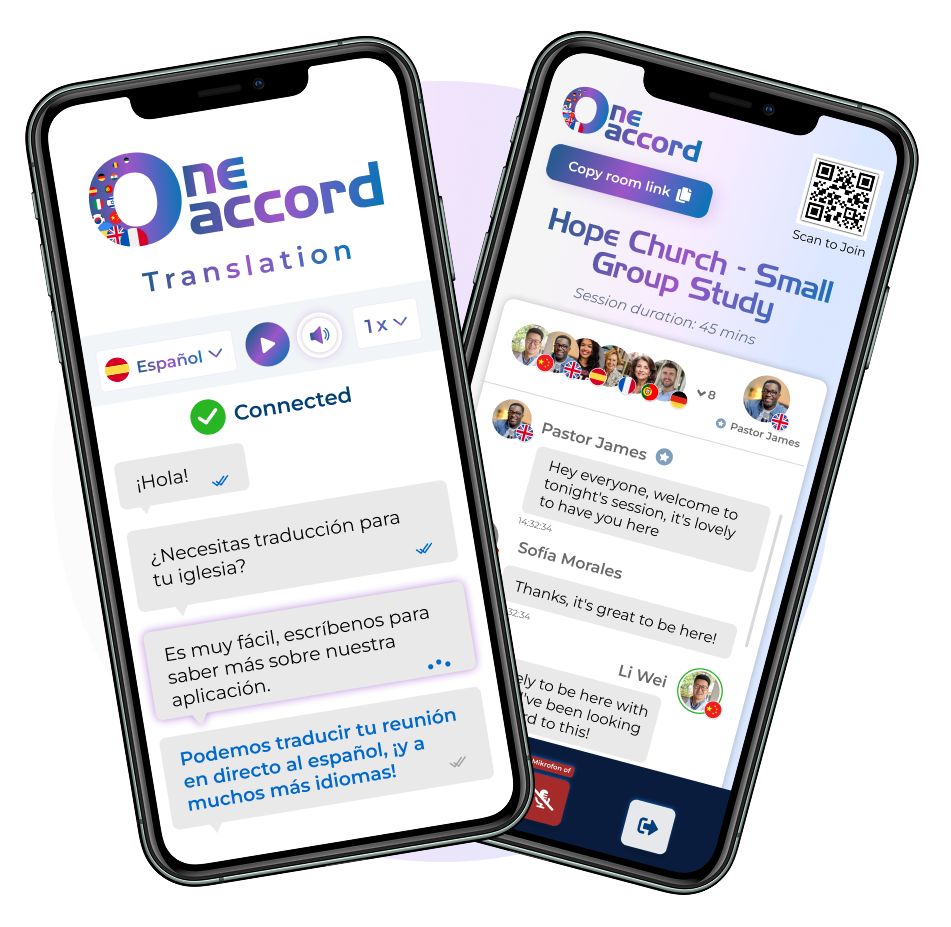
AI translation, in short, is translation software – either running from a web browser (like ours), your desktop, or from an app – that takes speech audio from your service in order for the company’s AI to transcribe and then translate into multiple languages. Your translation users receive the translation via their cell phones, either as written translation, audio translation, or both.
This option removes the need for transmitters, receivers, and a drawer full of batteries and swaps them for basic setups that often need no more than your church’s sound desk, a laptop/iPad, a stable WiFi connection, and a couple of cables.
Some platforms like ours use QR codes that take your listeners straight to your translation page, while other platforms provide apps from which your listeners can access the translation. Once logged in, listeners can access AI-generated translation from their own smartphones, giving them either text captions or audio translation through their own earbuds within seconds.
What AI translation costs – AI translation platforms in this category tend to be priced by usage. For example, our subscription tiers are based on the number of translation listeners, languages, and monthly usage hours needed.
What AI translation does genuinely well:
- Inexpensive solution for churches that have no interpreters.
- Churches with limited interpreter availability can use this to fill empty rota spots or cover unsupported languages.
- Can be easily scaled up to more listeners or languages by changing subscription plan.
- Can serve multiple languages simultaneously.
- Can double up as a live-caption service for deaf and hard-of-hearing members.
Where it strains:
- Lack of Wi-Fi or cell coverage means no translation.
- Churches may need basic smartphones and earbuds for translation users who don’t have either.
- Can convey words, often with realistic pronunciation, but cannot yet replicate your speaker’s inflections or passion in real-time.
Quality assurance
From our experience with AI translation, quality is a process, not a slogan. We've written at length about what accuracy really requires in live church translation, so we won’t rehash that here. However, whichever provider you choose, hold them to a standard based on more than just marketing claims.
A tool, not a takeover: AI translation
If you're wondering whether AI translation has any place in a church blessed with human interpreters, naturally, our answer at OneAccord is yes. But we believe it should be a supplement to, not a replacement for interpreters.
You can equip and support your interpreters to continue to serve the languages they translate, while using live AI translation for any languages where you don’t have interpreters available - for example, the vacationing family from Poland; the new Indian couple who speak Malayalam; the students from Kenya who need Swahili translation; or the Vietnamese lady who finally accepted her neighbor’s invite to church. You can even use it to provide cover, so that an interpreter can go on vacation without the pastor worrying that those congregation members will be left feeling lost that weekend.
Best of both worlds: the hybrid approach
If your church has a thriving translation team, but your main pain point is the ever-expanding hardware budget, then some platforms offer a hybrid option that deserves consideration.
Companies such as Interactio and LiveVoice can carry your interpreter’s audio directly to your listeners’ smartphones, skipping over the need for receivers. So your interpreters can continue to use hardware that they’re familiar with, while you streamline the user’s side of the translation.
Whatever you buy, the audio feed decides
This is a common denominator we’ve seen with every system on this page. Translation quality, whether human or AI, is won or lost at the sound desk, before one word has been translated.
The impact of your interpreter hearing or mishearing a word or sentence due to the quality of their audio feed can change the whole context of what’s being preached to your translation users.
Therefore, before you spend a dollar on translation equipment, spend some serious time on these points:
- Build bridges between translation and sound teams. This may save you wasted time and energy on busy Sundays.
- Show, don’t tell. Where possible, help your sound team see what your interpreters are trying to achieve, rather than just adding to their to-do list. What is unowned will always drift, so let your techs in on the vision, and they can then take ownership of their part in it.
- Check any potential system purchases with your sound team first to make sure there are no risks of clashing equipment. You are saving them hours of frustration in advance.
- Ask your sound tech if they can dedicate a specific auxiliary (AUX) output for translation, from the sound desk into your translation system.
Conclusion: a question worth sitting with
In the United States alone, nearly 68 million people – almost one in five – speak a language other than English at home, according to the U.S. Census Bureau. Some of them will walk into your church this year.
We encourage you to choose whichever option is the best fit for your church, but don’t lose sight of the question at the heart of this: when those people walk in, will they understand what they hear?
If the right answer for your church is using well-maintained receivers to support a faithful interpreter - then we hope you have found some helpful information in this article. And if the smartphone-and-AI path might be part of your answer, we'll give you free credits to test it in a real service, with a real person helping you get the audio right.
Frequently asked questions
What equipment do I need to translate a church service?
At minimum: a clean audio feed from your sound desk, plus either:
- A traditional setup - an interpreter, a transmitter, and a wireless receiver + 1 headset per listener.
- A smartphone-based platform, where listeners scan a QR code and use their own phones and earbuds, with translation provided by AI, an interpreter, or both where needed.
How much does church translation equipment cost?
It depends heavily on tier:
- Budget tour-guide-style systems can start at a few hundred dollars per bundle.
- Large multi-transmitter packages can run into the low thousands.
- Professional, assistive-listening systems can cost more still, with individual receivers often over $100 each.
- All hardware carries ongoing costs for batteries, headsets, receivers, and replacements.
- Smartphone-based platforms like ours have no hardware costs, but are priced by usage - Our platform starts at $150 per month, based on translation listeners, languages, and hours rather than congregation size.
Do translation headsets work with AI translation?
They can. Some AI translation platforms like ours can be fed into your existing transmitters, so your members can keep the headset setup they’re used to.
Do we still need our interpreters if we use AI translation?
Yes! If you have gifted interpreters, keep them and equip them well. Use AI to:
- Increase the number of translation languages you have available
- Give your interpreters a break if you have a small team
- Provide captions for deaf and hard-of-hearing members
The two can serve side by side every Sunday!